Introduction
NoSQL database platforms store and retrieve data using models beyond traditional relational tables. They are designed to handle flexible schemas, high scale workloads, and specialized access patterns such as key value lookups, document storage, wide column analytics, and graph relationships. NoSQL is often chosen when data structures change frequently, when massive throughput is required, or when the application needs a data model that fits naturally without heavy joins.
Real world use cases include user profile storage for large apps, product catalogs and content systems, event logging and time series ingestion, caching and session stores, IoT data collection, recommendation engines, fraud detection pipelines, and graph based relationship queries. When selecting a NoSQL platform, evaluate data model fit, consistency options, scaling approach, operational complexity, query capabilities, indexing, high availability, replication and disaster recovery, security controls, ecosystem tooling, and cost.
Best for
Engineering teams, data platform teams, and product teams building scalable applications that need flexible schemas, high throughput, low latency, or specialized models such as document, key value, wide column, time series, or graph.
Not ideal for
Strict transactional systems requiring complex joins and rigid schemas as the default, or teams that need heavy relational reporting without building additional analytics layers.
Key Trends in NoSQL Database Platforms
- Wider adoption of managed NoSQL services to reduce operational burden
- More support for multi model databases that combine document, key value, and graph features
- Increased focus on global replication and multi region availability
- Stronger consistency options while still supporting high performance
- More built in security features such as encryption, auditing, and fine grained access control
- Growth of time series and event workloads driven by observability and IoT
- More integration with streaming platforms for real time data pipelines
- Improved tooling for backups, point in time recovery, and disaster recovery
- Better query languages and indexing for developer productivity
- More focus on cost control through tiering, autoscaling, and smarter storage engines
How We Selected These Tools (Methodology)
- Selected widely used NoSQL platforms across different data models and industries
- Balanced open source, commercial, and cloud native options
- Included document, key value, wide column, graph, and time series oriented platforms
- Considered scalability, availability, and operational maturity
- Evaluated developer experience and query capabilities for real use cases
- Considered ecosystem and integrations with modern application stacks
- Avoided assuming ratings, certifications, or pricing not clearly known
- Focused on platforms that remain relevant for modern scalable architectures
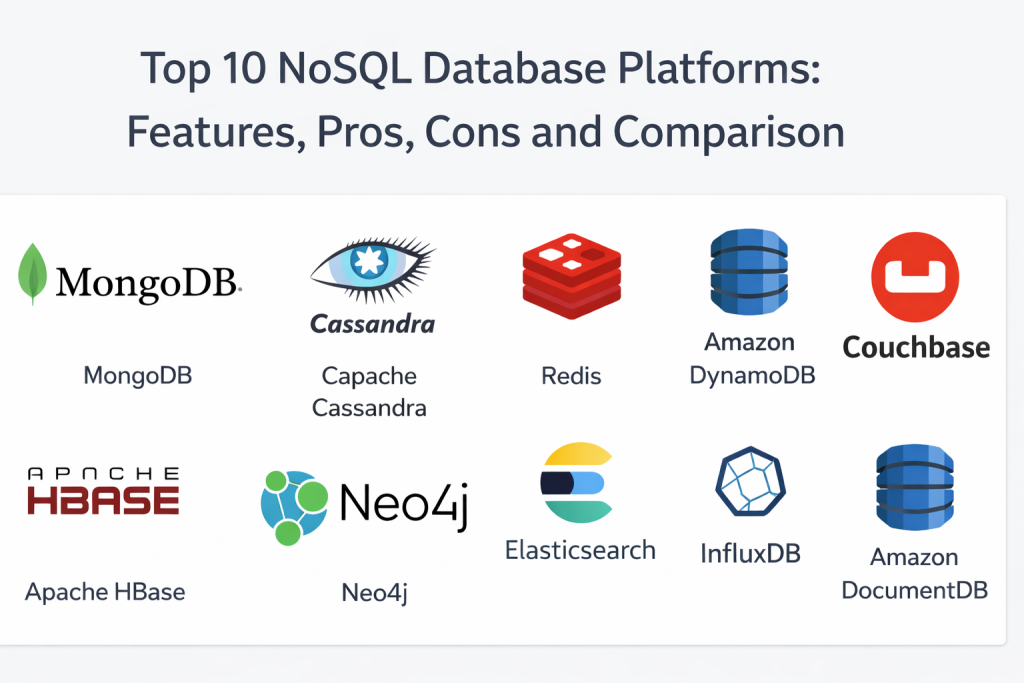
Top 10 NoSQL Database Platforms
1 — MongoDB
Document database designed for flexible schema storage and developer friendly querying. Often used for applications where data structures evolve and where documents map well to application objects.
Key Features
- Document oriented storage with flexible schemas
- Indexing options for query performance
- Replication and high availability patterns
- Sharding for horizontal scaling
- Rich query and aggregation capabilities
- Strong ecosystem of drivers and connectors
- Tools for backups and operational workflows depending on setup
Pros
- Strong developer productivity for document data
- Flexible schema supports fast iteration
- Widely adopted with broad tooling ecosystem
Cons
- Data modeling needs discipline to avoid performance issues
- Complex joins are not the default strength
- Scaling and tuning require planning for large deployments
Platforms and Deployment
Windows, macOS, Linux, Cloud, Self hosted, Hybrid
Security and Compliance
Access control and encryption expectations exist; certifications: Not publicly stated.
Integrations and Ecosystem
MongoDB integrates with many frameworks, analytics pipelines, and monitoring stacks, and is commonly used as a core data store for content and application services.
- Strong driver support across languages
- Works with ETL and streaming pipelines
- Integrates with monitoring and backup tooling
- Common in modern application architectures
Support and Community
Large community and broad documentation. Support options vary: Varies / Not publicly stated.
2 — Apache Cassandra
Wide column database designed for high throughput, high availability, and horizontal scaling. Often used for large scale distributed workloads that require fast writes and resilient replication.
Key Features
- Distributed architecture for horizontal scaling
- High write throughput for event and time based workloads
- Replication and multi data center support
- Tunable consistency options for flexibility
- Partitioning model for predictable scaling
- Strong availability patterns for large deployments
- Works well for large time series and logging data
Pros
- Strong for massive scale and high availability
- Handles high write loads reliably
- Good for multi data center resilience
Cons
- Data modeling requires careful partition design
- Query flexibility is more limited than document databases
- Operational complexity can be high without expertise
Platforms and Deployment
Linux, Cloud, Self hosted, Hybrid
Security and Compliance
Access control depends on configuration; certifications: Not publicly stated.
Integrations and Ecosystem
Commonly used with streaming platforms and analytics pipelines where high write ingestion and scalable storage are needed.
- Integrates with streaming ingestion pipelines
- Works with large scale monitoring and observability systems
- Supports multi region replication patterns
- Fits distributed operations workflows
Support and Community
Strong open source community. Commercial support options vary: Varies / Not publicly stated.
3 — Redis
In memory key value data platform used for caching, sessions, real time data, and fast lookups. Often used to reduce database load and speed up application response times.
Key Features
- In memory key value storage for low latency access
- Data structures for lists, sets, hashes, and more
- Persistence options depending on configuration
- Replication and high availability features
- Pub sub patterns for messaging use cases
- TTL support for caches and sessions
- Strong ecosystem for application acceleration
Pros
- Extremely fast for caching and real time workloads
- Simple integration into most application stacks
- Useful for sessions, queues, and rate limiting
Cons
- Not ideal as the only system of record for all data
- Memory cost can be high for large datasets
- Persistence and durability need careful configuration
Platforms and Deployment
Windows, macOS, Linux, Cloud, Self hosted, Hybrid
Security and Compliance
Access control depends on deployment setup; certifications: Not publicly stated.
Integrations and Ecosystem
Redis integrates easily with web frameworks, background job systems, and caching layers to improve performance and reduce load on primary databases.
- Works with common frameworks and caching libraries
- Integrates with message and queue style patterns
- Supports monitoring and scaling workflows
- Fits hybrid and cloud deployments
Support and Community
Large community and broad usage. Support varies: Varies / Not publicly stated.
4 — Amazon DynamoDB
Managed key value and document database service designed for high scale and low latency workloads. Often used for serverless and cloud native applications that need reliable scaling.
Key Features
- Managed scaling for high throughput workloads
- Key value and document style data model support
- Global replication capabilities depending on setup
- Backup and recovery features in managed form
- Fine grained access control through cloud identity policies
- Low latency performance for operational workloads
- Integrates well with cloud native application services
Pros
- Strong scaling with low operational overhead
- Good fit for event driven and serverless architectures
- Reliable low latency performance for many workloads
Cons
- Data modeling requires careful partition key planning
- Query flexibility can be limited compared to SQL
- Cost control needs monitoring at high throughput
Platforms and Deployment
Web, Cloud
Security and Compliance
Cloud IAM based access controls expected; certifications: Not publicly stated.
Integrations and Ecosystem
DynamoDB fits cloud native architectures and often integrates with event systems, serverless compute, and application services for scalable operational data storage.
- Integrates with cloud identity policies for access control
- Works with serverless and event driven architectures
- Supports monitoring and audit workflows through cloud tools
- Commonly used for scalable operational state storage
Support and Community
Support depends on cloud support plan. Documentation is strong: Varies / Not publicly stated.
5 — Couchbase
NoSQL platform combining document storage with key value style performance and caching patterns. Often used for high performance applications that need flexible data models and low latency.
Key Features
- Document database with flexible schema support
- Key value access patterns for speed
- Built in replication and high availability features
- Query capabilities for documents and indexes
- Mobile and edge sync patterns depending on setup
- Caching friendly architecture for low latency apps
- Operational tools for cluster management
Pros
- Strong low latency performance for many workloads
- Useful combination of document and key value patterns
- Good availability and replication features
Cons
- Operational complexity increases with cluster scale
- Query performance depends on indexing and design
- Costs and licensing depend on edition and deployment
Platforms and Deployment
Windows, Linux, Cloud, Self hosted, Hybrid
Security and Compliance
Role based access expected; certifications: Not publicly stated.
Integrations and Ecosystem
Couchbase integrates with modern application stacks and supports caching and document workflows, often used in mobile and edge scenarios where sync matters.
- Integrates with application frameworks and SDKs
- Supports cluster and replication management workflows
- Works with caching and low latency architectures
- Fits hybrid and edge deployment patterns
Support and Community
Community and enterprise support options exist. Exact details: Varies / Not publicly stated.
6 — Apache HBase
Wide column database built for large scale storage on top of Hadoop style ecosystems. Often used for big data workloads, high throughput ingestion, and large table storage with predictable access patterns.
Key Features
- Distributed wide column storage for large datasets
- Strong for high throughput ingestion workloads
- Works well in Hadoop ecosystem environments
- Supports large scale storage across nodes
- Provides low latency access for specific patterns
- Designed for large tables and sparse data
- Integrates with big data processing pipelines
Pros
- Strong for huge datasets and big data ecosystems
- Good for predictable access patterns at scale
- Works well with large ingestion pipelines
Cons
- Operational complexity can be high
- Query patterns are limited compared to document databases
- Best fit often depends on Hadoop ecosystem adoption
Platforms and Deployment
Linux, Cloud, Self hosted, Hybrid
Security and Compliance
Depends on ecosystem configuration: Varies / Not publicly stated.
Integrations and Ecosystem
HBase is commonly integrated into big data pipelines where ingestion and large scale storage are key requirements, often combined with batch and streaming processing.
- Integrates with Hadoop and distributed storage systems
- Used with ETL and analytics pipelines
- Works with high throughput ingestion workflows
- Fits large scale data platform architectures
Support and Community
Open source community usage. Enterprise support varies: Varies / Not publicly stated.
7 — Neo4j
Graph database designed for relationship heavy queries, such as networks, recommendations, fraud links, and connected data. Often used when graph traversal and relationship analytics are core requirements.
Key Features
- Graph data model for nodes and relationships
- Fast relationship traversal and path queries
- Query language designed for graph patterns
- Indexing and constraints for graph integrity
- Supports fraud, recommendation, and network use cases
- Tools for visualization and graph exploration
- Availability and scaling options depending on setup
Pros
- Excellent for relationship based data and queries
- Strong fit for fraud and recommendation scenarios
- Clear modeling for connected data problems
Cons
- Not the best fit for simple key value workloads
- Scaling and operations depend on edition and architecture
- Requires different modeling mindset than relational databases
Platforms and Deployment
Windows, Linux, Cloud, Self hosted, Hybrid
Security and Compliance
Access controls expected; certifications: Not publicly stated.
Integrations and Ecosystem
Neo4j integrates with applications and analytics workflows where relationship queries are central, and is often used alongside other databases rather than replacing them entirely.
- Integrates with application services and APIs
- Works with data pipelines feeding relationship data
- Supports analytics and exploration workflows
- Often combined with relational or document databases
Support and Community
Strong community with commercial support options. Exact details: Varies / Not publicly stated.
8 — Elasticsearch
Search and analytics engine often used for log analytics, full text search, and fast indexing based queries. Commonly used as a specialized NoSQL platform for search workloads rather than general transaction storage.
Key Features
- Index based storage optimized for search queries
- Full text search capabilities
- Aggregations for analytics and dashboards
- High throughput ingestion for logs and events
- Clustered architecture for scaling and replication
- Near real time indexing and query performance
- Works well for observability and search applications
Pros
- Strong for search, log analytics, and indexing workloads
- Fast queries for text and filtered searches
- Scales well for event ingestion with proper design
Cons
- Not ideal as a primary system of record for transactions
- Resource usage can be high at scale
- Data modeling and index management require expertise
Platforms and Deployment
Windows, Linux, Cloud, Self hosted, Hybrid
Security and Compliance
Security features depend on deployment and configuration: Varies / Not publicly stated.
Integrations and Ecosystem
Elasticsearch is commonly integrated with logging pipelines, observability stacks, and application search features, often paired with ingestion agents and dashboards.
- Integrates with logging and event ingestion pipelines
- Works with monitoring and analytics dashboards
- Supports application search features and APIs
- Fits observability and search heavy architectures
Support and Community
Large community and commercial support options exist. Exact details: Varies / Not publicly stated.
9 — InfluxDB
Time series database designed for metrics, events, and time based data. Often used for monitoring, IoT telemetry, and observability workloads requiring high write ingestion and time range queries.
Key Features
- Time series optimized storage and queries
- High throughput ingestion for metrics and events
- Retention policies and downsampling options
- Query support designed for time range analysis
- Supports dashboards and alerting integrations
- Good fit for IoT and observability pipelines
- Works with high volume telemetry systems
Pros
- Strong for time series data and metrics workloads
- Efficient time based queries and retention handling
- Useful for observability and IoT telemetry storage
Cons
- Not designed for general document or relational workloads
- Scaling depends on architecture and edition
- Data modeling requires understanding time series patterns
Platforms and Deployment
Windows, macOS, Linux, Cloud, Self hosted, Hybrid
Security and Compliance
Access control depends on setup; certifications: Not publicly stated.
Integrations and Ecosystem
InfluxDB is often integrated into monitoring stacks and telemetry pipelines where data arrives continuously and must be queried by time windows.
- Integrates with metrics and telemetry collectors
- Works with dashboards and alerting workflows
- Supports ingestion from IoT devices and sensors
- Fits observability data pipeline architectures
Support and Community
Community adoption is broad. Support varies by plan: Varies / Not publicly stated.
10 — Amazon DocumentDB
Managed document database service designed to support document workloads in AWS environments. Often used by teams wanting managed operations while using document style data models.
Key Features
- Managed document database operations in AWS
- Compatibility patterns for document based applications
- Automated backups and recovery features
- High availability configurations in managed form
- Integration with AWS security and identity controls
- Scales for many operational document workloads
- Works well for cloud native application architectures
Pros
- Lower operational overhead for document workloads in AWS
- Integrates well with AWS security and monitoring tools
- Useful for teams standardizing on AWS managed services
Cons
- Primarily tied to AWS ecosystem
- Feature depth and behavior depend on service characteristics
- Migration validation needed for application compatibility expectations
Platforms and Deployment
Web, Cloud
Security and Compliance
IAM style access controls and encryption expectations exist; certifications: Not publicly stated.
Integrations and Ecosystem
Amazon DocumentDB integrates with AWS application services, monitoring, and identity tools, supporting document workloads inside cloud native architectures.
- Integrates with AWS identity and security policies
- Works with cloud monitoring and alert workflows
- Fits application services running in AWS
- Supports managed backup and availability patterns
Support and Community
Support depends on AWS support plan. Documentation is broad: Varies / Not publicly stated.
Comparison Table
| Tool Name | Best For | Platform(s) Supported | Deployment | Standout Feature | Public Rating |
|---|---|---|---|---|---|
| MongoDB | Flexible document data for applications | Windows, macOS, Linux | Cloud, Self hosted, Hybrid | Rich document queries and broad ecosystem | N/A |
| Apache Cassandra | High write distributed storage | Linux | Cloud, Self hosted, Hybrid | Horizontal scaling with tunable consistency | N/A |
| Redis | Low latency caching and sessions | Windows, macOS, Linux | Cloud, Self hosted, Hybrid | In memory speed and data structures | N/A |
| Amazon DynamoDB | Managed high scale key value workloads | Web | Cloud | Low ops scaling for operational state | N/A |
| Couchbase | Low latency document and key value patterns | Windows, Linux | Cloud, Self hosted, Hybrid | Document plus key value performance in one platform | N/A |
| Apache HBase | Large scale wide column storage | Linux | Cloud, Self hosted, Hybrid | Big data ecosystem wide column storage | N/A |
| Neo4j | Relationship driven queries and graphs | Windows, Linux | Cloud, Self hosted, Hybrid | Fast graph traversal and relationship analytics | N/A |
| Elasticsearch | Search and log analytics workloads | Windows, Linux | Cloud, Self hosted, Hybrid | Index based search and aggregations | N/A |
| InfluxDB | Time series and metrics storage | Windows, macOS, Linux | Cloud, Self hosted, Hybrid | Time series optimized ingestion and queries | N/A |
| Amazon DocumentDB | Managed document workloads in AWS | Web | Cloud | Managed operations for document applications | N/A |
Evaluation and Scoring of NoSQL Database Platforms
The scores below compare NoSQL platforms across common selection criteria. A higher weighted total suggests a stronger overall balance, but the best choice depends on your data model needs and workload patterns. Document databases are strong for flexible application data, wide column systems are strong for high write scale, key value stores are strong for low latency, search engines are strong for indexing workloads, and graph or time series platforms are best for specialized queries. Use these scores to shortlist options, then validate with a proof of concept using your real data size, query patterns, and availability needs. Scoring is comparative and should be interpreted based on your priorities.
Weights used: Core 25 percent, Ease 15 percent, Integrations 15 percent, Security 10 percent, Performance 10 percent, Support 10 percent, Value 15 percent.
| Tool Name | Core (25%) | Ease (15%) | Integrations (15%) | Security (10%) | Performance (10%) | Support (10%) | Value (15%) | Weighted Total |
|---|---|---|---|---|---|---|---|---|
| MongoDB | 9 | 8 | 8 | 7 | 8 | 7 | 7 | 8.00 |
| Apache Cassandra | 8 | 6 | 7 | 6 | 9 | 7 | 8 | 7.55 |
| Redis | 8 | 8 | 8 | 6 | 9 | 7 | 7 | 7.85 |
| Amazon DynamoDB | 8 | 9 | 8 | 7 | 9 | 7 | 6 | 8.00 |
| Couchbase | 8 | 7 | 7 | 7 | 8 | 7 | 6 | 7.35 |
| Apache HBase | 7 | 5 | 6 | 6 | 8 | 6 | 8 | 6.75 |
| Neo4j | 8 | 7 | 7 | 7 | 8 | 7 | 6 | 7.35 |
| Elasticsearch | 8 | 6 | 8 | 6 | 8 | 7 | 6 | 7.20 |
| InfluxDB | 7 | 7 | 7 | 6 | 8 | 7 | 7 | 7.10 |
| Amazon DocumentDB | 7 | 8 | 7 | 7 | 8 | 7 | 6 | 7.25 |
Which NoSQL Database Platform Is Right for You
Solo / Freelancer
If you are building small apps, choose a platform that matches your data model and is easy to operate. MongoDB is a strong choice for flexible app data. Redis is useful for caching and sessions. If your project is search heavy, Elasticsearch can power fast search and filtering, but it is best used as a specialized store rather than a complete system of record.
SMB
SMBs often need fast delivery with manageable operations. MongoDB is commonly used for product catalogs, user profiles, and content. Redis improves speed and reduces load on primary databases. If you are building on AWS, Amazon DynamoDB can offer high scale with low operations, especially for event driven architectures. Choose the simplest platform that fits your access pattern, and avoid running many specialized databases without ownership.
Mid Market
Mid market teams often need scalability, resilience, and strong operational processes. Amazon DynamoDB can be strong for predictable access patterns. Apache Cassandra is a fit when write scale and multi region resilience are core requirements, but it needs careful data modeling and operations. Couchbase can help when low latency document access and caching are both important. If you need relationship queries, Neo4j is a strong specialized choice.
Enterprise
Enterprises often need governance, durability, and multi environment consistency. Apache Cassandra and Amazon DynamoDB fit large scale workloads, while MongoDB is widely used across enterprise applications for document data. Elasticsearch is often part of observability and search ecosystems. For telemetry, InfluxDB can store time series data efficiently. Enterprises should standardize platforms to reduce skill fragmentation and ensure backup, security, and monitoring are consistent.
Budget vs Premium
Open source platforms can be cost effective but require operations and expertise. Managed services reduce operational burden but can cost more at scale. The right decision depends on whether you want to pay with engineering time or service fees.
Feature Depth vs Ease of Use
MongoDB and managed services often provide faster developer onboarding. Cassandra and HBase provide scale but require deeper expertise. Specialized platforms like Neo4j, InfluxDB, and Elasticsearch offer deep capability for their niche but are not general replacements for all data storage needs.
Integrations and Scalability
Consider how the platform fits into your application architecture, streaming pipelines, and monitoring stack. Cassandra fits well with event ingestion pipelines, Redis integrates widely for caching, and DynamoDB integrates deeply with AWS. For search, Elasticsearch fits best when paired with a primary system of record and a reliable ingestion pipeline.
Security and Compliance Needs
NoSQL security depends on strong access control, encryption, auditing, and backup discipline. Ensure your platform supports least privilege access and that your team can prove who accessed data and when. Also ensure disaster recovery is tested, because many NoSQL outages are operational rather than purely technical.
Frequently Asked Questions
1. What is the main difference between NoSQL and relational databases?
NoSQL databases often use flexible schemas and specialized data models such as document, key value, or graph. Relational databases use structured tables and joins with strong relational constraints by default.
2. When should we choose a document database?
Choose a document database when your data maps naturally to objects, changes frequently, and you want flexible schemas with rich querying. It is common for catalogs, profiles, and content.
3. When is a key value database the best fit?
Key value databases are best when your access pattern is mostly lookups by key and you need very low latency and high throughput. They are common for sessions, state, and caching.
4. Is Redis a database or a cache?
It can be both, but it is most commonly used as a cache and real time data store. If you use it as a system of record, you must configure durability and recovery carefully.
5. Why is data modeling important in Cassandra and DynamoDB?
Because query patterns depend heavily on partition keys and access design. Poor modeling can cause hotspots, high latency, and expensive scans.
6. Should we use Elasticsearch as the main database?
Usually no. Elasticsearch is best for search and analytics indexing. Many teams use a primary database for source of truth and sync relevant data into Elasticsearch for search.
7. What makes a graph database valuable?
Graph databases are valuable when relationships and traversals are core queries, such as fraud networks, recommendations, and dependency graphs. They often outperform relational approaches for deep relationship queries.
8. What is the best NoSQL choice for time series data?
Time series databases are optimized for time based ingestion and retention policies. InfluxDB is commonly used for metrics and telemetry workloads.
9. How do we plan backups for NoSQL databases?
Backups depend on platform and deployment model. Ensure you have point in time recovery where possible, test restores regularly, and validate that backups meet your recovery time targets.
10. How do we choose the right NoSQL platform?
Start with your data model and access patterns, then shortlist platforms that match. Build a proof of concept with realistic data volume and queries, evaluate cost and operational effort, and select the simplest platform that meets your reliability goals.
Conclusion
NoSQL platforms are powerful because they match real world application needs that do not fit neatly into relational tables, especially when scale, flexibility, and specialized access patterns are required. The best platform depends on whether you need flexible documents, fast key value access, wide column write scale, relationship queries, time series storage, or search indexing. Many successful architectures use multiple NoSQL platforms, but only when there is clear ownership, consistent security controls, and proven backup and recovery processes. A practical next step is to shortlist two or three candidates, run a proof of concept using your real data and queries, validate scaling and availability behavior, and confirm operational effort and cost before standardizing for production.

Best Cardiac Hospitals Near You
Discover top heart hospitals, cardiology centers & cardiac care services by city.
Advanced Heart Care • Trusted Hospitals • Expert Teams
View Best Hospitals