Introduction
Event streaming platforms move events from producers to consumers in a reliable, scalable, and near real-time way. An “event” can be anything meaningful that happens in a system, such as a user clicking a button, a payment being approved, an order shipping, a sensor reading arriving, or a service logging an error. Instead of moving data in batches, event streaming platforms allow teams to react instantly, build real-time analytics, and connect microservices without tight coupling.
This matters now because modern systems are distributed, customer expectations are immediate, and businesses need fast feedback loops. Event streaming powers real-world use cases like fraud detection, real-time personalization, activity tracking, order and inventory updates, log and telemetry pipelines, and reliable communication between services in large architectures.
When evaluating an event streaming platform, buyers should focus on throughput and latency, durability and delivery guarantees, partitioning and ordering behavior, consumer scalability, schema management, security controls, observability, multi-region replication, operational complexity, and total cost across infrastructure and administration.
Best for: data engineering teams, platform teams, SRE, backend engineers, product teams building event-driven systems, and organizations that need reliable real-time pipelines; industries like fintech, e-commerce, telecom, gaming, logistics, and IoT.
Not ideal for: teams that only need occasional batch transfers; organizations without clear event design or ownership; use cases that require deep analytics rather than event transport; small projects where a simple queue is enough and long-term streaming infrastructure is unnecessary.
Key Trends in Event Streaming Platforms
- More organizations are standardizing on event-driven architecture for better decoupling and resilience.
- Managed cloud streaming is growing to reduce operational load and improve reliability.
- Multi-region replication and disaster recovery are becoming expected for critical event flows.
- Schema governance is gaining importance to prevent breaking changes and data chaos.
- More teams want unified streaming plus stream processing patterns in one ecosystem.
- Security expectations are higher, including fine-grained access control and auditability.
- Observability is a deciding factor, including lag monitoring, throughput tracking, and consumer health.
- Cost predictability is becoming a major requirement due to always-on streaming workloads.
- Interoperability and open protocols are valued to reduce lock-in and ease integrations.
- Streaming is increasingly used beyond engineering, powering near real-time dashboards and operational analytics.
How We Selected These Tools (Methodology)
- Chosen based on widespread adoption and credibility for production event streaming.
- Prioritized platforms with strong durability, scalability, and delivery guarantees.
- Included a mix of open-source standards, cloud-managed services, and cloud-native designs.
- Considered ecosystem depth: connectors, integrations, stream processing compatibility, and tooling.
- Evaluated operational patterns such as scaling, upgrades, and multi-cluster management.
- Considered security posture signals and common enterprise expectations, without inventing claims.
- Included options that fit different segments from startups to enterprise.
- Used “Not publicly stated” or “Varies / N/A” where details are uncertain.
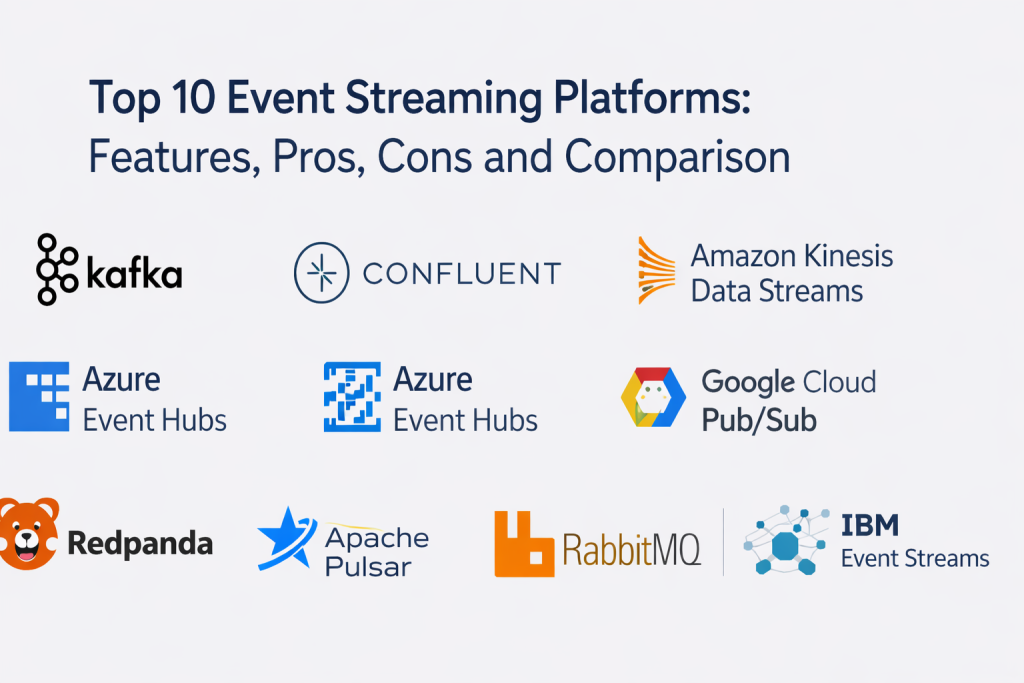
Top 10 Event Streaming Platforms
Tool 1 — Apache Kafka
Apache Kafka is a widely adopted distributed event streaming platform built for high-throughput, durable event pipelines. It is commonly used as the backbone of event-driven architectures and real-time data integration.
Key Features
- Durable publish-subscribe event streaming with partitions
- High throughput for large event volumes
- Consumer groups for scalable parallel processing
- Strong ecosystem of connectors and tooling (Varies)
- Exactly-once style processing patterns in some workflows (Varies)
- Stream processing compatibility through ecosystem tools (Varies)
- Multi-cluster and replication patterns (Varies)
Pros
- Industry-standard adoption and large ecosystem
- Strong scalability for high-volume event pipelines
- Fits many event-driven and data engineering use cases
Cons
- Operational complexity can be high without strong platform ownership
- Requires careful partition planning and governance
- Multi-region and DR patterns need deliberate design
Platforms / Deployment
- Linux (common)
- Self-hosted / Hybrid (Varies)
Security & Compliance
- Not publicly stated
Integrations & Ecosystem
Kafka is central to many modern data stacks and integrates broadly through connectors, clients, and platform tooling.
- Large connector ecosystem for databases and SaaS apps (Varies)
- Wide client support across programming languages
- Integration with stream processing engines (Varies)
- Monitoring and management tooling options (Varies)
- Schema and governance tooling through ecosystem products (Varies)
Support & Community
Very strong community, extensive documentation and learning resources. Enterprise support depends on vendors and internal expertise.
Tool 2 — Confluent Platform
Confluent Platform is an enterprise distribution built around Kafka, often chosen for teams that want Kafka’s strengths with additional management, governance, and operational tooling.
Key Features
- Kafka-based event streaming with enterprise tooling
- Connector and integration capabilities (Varies)
- Stream governance features such as schema workflows (Varies)
- Cluster management and monitoring tools (Varies)
- Data replication and multi-cluster patterns (Varies)
- Security and access control options (Varies)
- Support and onboarding resources (Varies)
Pros
- Strong operational tooling for Kafka-based environments
- Often faster enterprise adoption with guided patterns
- Rich ecosystem for connectors and governance
Cons
- Can be costly at scale depending on usage and licensing
- Still requires good event design and ownership discipline
- Vendor feature depth varies by edition and deployment model
Platforms / Deployment
- Linux (common) / Web management (Varies)
- Cloud / Self-hosted / Hybrid (Varies)
Security & Compliance
- Not publicly stated
Integrations & Ecosystem
Confluent is often selected for large Kafka programs that need broad connectivity and strong operational support.
- Connector library for common systems (Varies)
- Schema and governance tooling (Varies)
- Replication tooling for multi-cluster use (Varies)
- APIs for automation and management (Varies)
- Partner ecosystem for enterprise implementations (Varies)
Support & Community
Strong vendor support and documentation, plus a large Kafka ecosystem that helps teams hire and train effectively.
Tool 3 — Amazon Kinesis Data Streams
Amazon Kinesis Data Streams is a managed event streaming service designed for real-time ingestion and processing within AWS environments. It is often used for clickstreams, logs, telemetry, and event-driven applications.
Key Features
- Managed streaming ingestion and durability
- Scaling patterns for throughput and consumer processing (Varies)
- Integration with AWS ecosystem services (Varies)
- Low-latency event consumption for applications
- Retention and replay capabilities (Varies)
- Monitoring and operational controls (Varies)
- Security integration with AWS identity patterns (Varies)
Pros
- Strong fit for AWS-centric architectures
- Managed operations reduce infrastructure burden
- Tight integration with AWS analytics and compute services
Cons
- Ecosystem portability is lower than open-source standards
- Cost planning can be complex for high-throughput workloads
- Feature design is oriented to AWS patterns and limits
Platforms / Deployment
- Web (via AWS tooling)
- Cloud
Security & Compliance
- Not publicly stated
Integrations & Ecosystem
Kinesis integrates well with AWS compute, storage, and analytics tools for end-to-end streaming pipelines.
- Integration with AWS services for processing and storage (Varies)
- Monitoring and alerting via AWS tooling (Varies)
- SDK support for application integration
- Common connectors through AWS ecosystem tools (Varies)
- Data pipeline building blocks within AWS (Varies)
Support & Community
Strong AWS documentation and support plans; community resources are extensive due to broad AWS adoption.
Tool 4 — Azure Event Hubs
Azure Event Hubs is a managed event ingestion and streaming service for Azure, commonly used for telemetry, logs, IoT events, and enterprise streaming pipelines.
Key Features
- Managed event streaming ingestion and buffering
- Partitioned consumption patterns for scaling consumers
- Integration with Azure ecosystem services (Varies)
- Retention and replay capabilities (Varies)
- Support for high-throughput telemetry scenarios (Varies)
- Monitoring and operational controls (Varies)
- Identity integration and access control patterns (Varies)
Pros
- Strong fit for Azure-first organizations
- Managed service reduces operational overhead
- Common choice for telemetry and enterprise ingestion
Cons
- Cloud-specific patterns can reduce portability
- Cost can rise with sustained throughput
- Advanced streaming governance needs extra design and tooling
Platforms / Deployment
- Web (via Azure tooling)
- Cloud
Security & Compliance
- Not publicly stated
Integrations & Ecosystem
Event Hubs connects well with Azure data and analytics services, supporting event-driven architectures within Azure.
- Integration with Azure processing and storage services (Varies)
- Monitoring through Azure platform tools (Varies)
- SDK support and client libraries
- Integration patterns with analytics platforms (Varies)
- Enterprise identity integration patterns (Varies)
Support & Community
Strong Microsoft documentation and partner ecosystem; many teams rely on Azure support tiers for production workloads.
Tool 5 — Google Cloud Pub/Sub
Google Cloud Pub/Sub is a managed messaging and event ingestion service built for global scale. It is often used for event-driven architectures, real-time pipelines, and cross-service communication within Google Cloud ecosystems.
Key Features
- Managed publish-subscribe messaging for events
- Global scalability patterns for distributed systems (Varies)
- Delivery and retry patterns for reliable consumption (Varies)
- Integration with Google Cloud services (Varies)
- Monitoring and operational controls (Varies)
- Access control integration patterns (Varies)
- Support for event-driven application patterns
Pros
- Strong managed scaling with minimal ops burden
- Practical for distributed and event-driven architectures
- Integrates well within Google Cloud environments
Cons
- Ecosystem portability lower than open-source standards
- Feature specifics depend on service configuration and usage
- Governance patterns require planning for large organizations
Platforms / Deployment
- Web (via Google Cloud tooling)
- Cloud
Security & Compliance
- Not publicly stated
Integrations & Ecosystem
Pub/Sub is commonly used as a central bus for event-driven application design and streaming ingestion.
- Integration with Google Cloud compute and analytics (Varies)
- SDK support for application integration
- Monitoring and alerting tools (Varies)
- Pipeline patterns for ingestion into analytics systems (Varies)
- Common integration via connectors and services (Varies)
Support & Community
Strong documentation and broad cloud community usage; enterprise support depends on Google Cloud support plans.
Tool 6 — Redpanda
Redpanda is a Kafka-compatible streaming platform designed for high performance and simpler operations. It is often chosen by teams that want Kafka-style APIs with a different architectural approach and reduced operational overhead.
Key Features
- Kafka-compatible APIs for producers and consumers (Varies)
- High-throughput streaming designed for low latency (Varies)
- Operational simplification features (Varies)
- Partitioning and consumer group support
- Integration with Kafka ecosystem tools (Varies)
- Cluster management and monitoring options (Varies)
- Replication and scaling patterns (Varies)
Pros
- Kafka compatibility reduces migration friction for many teams
- Strong performance focus for streaming workloads
- Often simpler operational footprint than large Kafka stacks
Cons
- Feature depth varies by edition and deployment model
- Ecosystem maturity differs compared to long-established Kafka tooling
- Platform choice still requires governance and event ownership
Platforms / Deployment
- Linux (common)
- Cloud / Self-hosted / Hybrid (Varies)
Security & Compliance
- Not publicly stated
Integrations & Ecosystem
Redpanda often fits teams that want Kafka compatibility with performance and operational simplification goals.
- Kafka client compatibility (Varies)
- Integration with common connectors and tooling (Varies)
- Monitoring and admin tooling options (Varies)
- APIs for automation (Varies)
- Stream processing integrations through ecosystem tools (Varies)
Support & Community
Growing community and vendor support options; adoption is strong in performance-focused teams.
Tool 7 — Apache Pulsar
Apache Pulsar is a distributed pub-sub platform designed for multi-tenancy and scalability. It is used for event streaming and messaging patterns, often in organizations that need flexible topic management and strong isolation.
Key Features
- Pub-sub messaging and event streaming at scale
- Multi-tenancy support patterns (Varies)
- Topic partitioning and subscription models
- Storage and compute separation patterns (Varies)
- Geo-replication options (Varies)
- Schema and message format support (Varies)
- Connector ecosystem options (Varies)
Pros
- Strong for multi-tenant environments and isolation needs
- Flexible subscription and consumption patterns
- Designed for scalable distributed architectures
Cons
- Operational complexity can be high without experienced ownership
- Ecosystem is smaller than Kafka in many environments
- Requires careful planning for governance and topic structure
Platforms / Deployment
- Linux (common)
- Self-hosted / Hybrid (Varies)
Security & Compliance
- Not publicly stated
Integrations & Ecosystem
Pulsar integrates through connectors and client libraries and is often used for large multi-tenant streaming programs.
- Connectors for data pipeline integrations (Varies)
- Client libraries across common languages
- Integration with stream processing tools (Varies)
- Monitoring and management tooling (Varies)
- Community ecosystem for extensions (Varies)
Support & Community
Active open-source community and documentation. Enterprise support depends on vendors or internal platform teams.
Tool 8 — RabbitMQ
RabbitMQ is a widely used message broker that supports event-driven architectures, especially for task distribution and service-to-service communication. It is often chosen when teams need reliable messaging patterns and flexible routing.
Key Features
- Messaging with multiple routing patterns (Varies)
- Reliability features like acknowledgements and retries (Varies)
- Support for flexible exchange types and routing keys
- Broad client library support across languages
- Operational tooling for queues and consumers (Varies)
- Plugin ecosystem for extensions (Varies)
- Clustering and high availability patterns (Varies)
Pros
- Mature and widely understood messaging platform
- Flexible routing patterns for microservices integration
- Strong fit for reliable work queues and event flows
Cons
- Not optimized for very large-scale log-style streaming like Kafka
- Throughput and replay patterns differ from log-based streaming
- Scaling requires careful architecture and monitoring
Platforms / Deployment
- Linux / Windows (Varies) / macOS (Varies)
- Cloud / Self-hosted / Hybrid (Varies)
Security & Compliance
- Not publicly stated
Integrations & Ecosystem
RabbitMQ fits well in service-to-service architectures and integrates through clients and plugins.
- Broad language client library ecosystem
- Integration with application frameworks (Varies)
- Monitoring and management tools (Varies)
- Plugins for protocol support and extensions (Varies)
- Integration into microservices patterns
Support & Community
Strong community, mature documentation, and many operational best practices available publicly.
Tool 9 — NATS
NATS is a lightweight messaging system designed for simplicity and performance, commonly used for microservices communication and real-time messaging patterns. It is popular when low latency and straightforward operations are priorities.
Key Features
- High-performance messaging for microservices
- Simple pub-sub patterns and request-reply workflows
- Scalable routing and clustering patterns (Varies)
- Support for durable messaging patterns through ecosystem options (Varies)
- Lightweight operational footprint
- Client library support across many languages
- Monitoring and observability features (Varies)
Pros
- Very low latency for real-time messaging needs
- Simple architecture and fast setup compared to heavier systems
- Strong fit for microservices and internal event buses
Cons
- Feature depth varies depending on persistence and durability needs
- Not always the best fit for large-scale log replay analytics
- Governance and schema controls require additional tooling
Platforms / Deployment
- Linux / Windows (Varies) / macOS (Varies)
- Cloud / Self-hosted / Hybrid (Varies)
Security & Compliance
- Not publicly stated
Integrations & Ecosystem
NATS integrates well with microservices stacks and developer-centric tooling for event-driven application design.
- Client libraries for common languages
- Integration into microservice frameworks (Varies)
- Observability tooling integrations (Varies)
- APIs for automation and management (Varies)
- Patterns for event-driven communication and messaging
Support & Community
Active community and strong documentation, especially among cloud-native and microservices teams.
Tool 10 — IBM Event Streams
IBM Event Streams is an enterprise event streaming offering often used by organizations that want Kafka-style streaming with enterprise support and integration into IBM-oriented environments.
Key Features
- Kafka-style streaming capabilities (Varies)
- Enterprise deployment patterns and tooling (Varies)
- Integration with enterprise data systems (Varies)
- Governance and access control patterns (Varies)
- Monitoring and operational management options (Varies)
- Support for large-scale event-driven architectures (Varies)
- Integration into enterprise workflows (Varies)
Pros
- Enterprise focus with vendor support options
- Useful for organizations aligned with IBM ecosystems
- Supports standardized event streaming programs
Cons
- Feature specifics vary by edition and deployment model
- Ecosystem breadth may differ compared to pure open-source stacks
- Cost and complexity depend on enterprise needs
Platforms / Deployment
- Web management (Varies) / Linux (common)
- Cloud / Self-hosted / Hybrid (Varies)
Security & Compliance
- Not publicly stated
Integrations & Ecosystem
IBM Event Streams typically integrates into larger enterprise architectures and can support multiple application and data pipeline patterns.
- Integration with enterprise platforms and tooling (Varies)
- APIs and connectors (Varies)
- Identity integration patterns (Varies)
- Monitoring integrations (Varies)
- Support for event-driven architectures at scale
Support & Community
Vendor support is a key strength; community resources vary based on deployment and customer segment.
Comparison Table (Top 10)
| Tool Name | Best For | Platform(s) Supported | Deployment (Cloud/Self-hosted/Hybrid) | Standout Feature | Public Rating |
|---|---|---|---|---|---|
| Apache Kafka | Standard event backbone at high scale | Linux (common) | Self-hosted / Hybrid | Huge ecosystem and adoption | N/A |
| Confluent Platform | Enterprise Kafka with management tooling | Linux (common) | Cloud / Self-hosted / Hybrid | Governance and ops tooling around Kafka | N/A |
| Amazon Kinesis Data Streams | AWS-native managed streaming pipelines | Web (via tooling) | Cloud | Deep AWS integration | N/A |
| Azure Event Hubs | Azure-native ingestion and event streaming | Web (via tooling) | Cloud | Telemetry and enterprise ingestion fit | N/A |
| Google Cloud Pub/Sub | Managed pub-sub at global scale | Web (via tooling) | Cloud | Scales easily for distributed systems | N/A |
| Redpanda | Kafka compatibility with performance focus | Linux (common) | Cloud / Self-hosted / Hybrid | Kafka-compatible with simpler ops goals | N/A |
| Apache Pulsar | Multi-tenant event streaming at scale | Linux (common) | Self-hosted / Hybrid | Strong multi-tenancy patterns | N/A |
| RabbitMQ | Reliable messaging with flexible routing | Linux / Windows (Varies) / macOS (Varies) | Cloud / Self-hosted / Hybrid | Mature broker for microservices patterns | N/A |
| NATS | Lightweight, low-latency messaging | Linux / Windows (Varies) / macOS (Varies) | Cloud / Self-hosted / Hybrid | Very low-latency pub-sub patterns | N/A |
| IBM Event Streams | Enterprise streaming with vendor support | Linux (common) | Cloud / Self-hosted / Hybrid | Enterprise-oriented event streaming | N/A |
Evaluation & Scoring of Event Streaming Platforms
Weights used: Core features 25%, Ease of use 15%, Integrations & ecosystem 15%, Security & compliance 10%, Performance & reliability 10%, Support & community 10%, Price / value 15%. Scores are comparative across common streaming scenarios and should be validated with a pilot that measures throughput, consumer lag, operational workload, and cost.
| Tool Name | Core (25%) | Ease (15%) | Integrations (15%) | Security (10%) | Performance (10%) | Support (10%) | Value (15%) | Weighted Total (0–10) |
|---|---|---|---|---|---|---|---|---|
| Apache Kafka | 9 | 6 | 9 | 6 | 8 | 9 | 8 | 8.05 |
| Confluent Platform | 9 | 7 | 9 | 6 | 8 | 8 | 6 | 7.85 |
| Amazon Kinesis Data Streams | 8 | 8 | 7 | 6 | 8 | 7 | 6 | 7.25 |
| Azure Event Hubs | 8 | 8 | 7 | 6 | 8 | 7 | 6 | 7.25 |
| Google Cloud Pub/Sub | 8 | 8 | 7 | 6 | 8 | 7 | 6 | 7.25 |
| Redpanda | 8 | 7 | 8 | 6 | 8 | 7 | 7 | 7.50 |
| Apache Pulsar | 8 | 6 | 7 | 6 | 8 | 7 | 7 | 7.10 |
| RabbitMQ | 7 | 8 | 7 | 6 | 7 | 8 | 8 | 7.35 |
| NATS | 7 | 8 | 6 | 6 | 8 | 7 | 8 | 7.20 |
| IBM Event Streams | 8 | 6 | 7 | 6 | 7 | 7 | 6 | 6.95 |
How to interpret the scores
- Weighted Total helps you shortlist, but the best fit depends on your architecture and constraints.
- If you need large-scale log streaming and replay, favor platforms designed for that pattern.
- If you need microservices messaging and low latency, a lighter broker can be the right choice.
- Always run a pilot to validate throughput, lag behavior, resiliency, and operational overhead.
Which Event Streaming Platform Is Right for You?
Solo / Freelancer
If you need event streaming for a small project, focus on ease, low operational overhead, and fast setup. NATS and RabbitMQ are often easier to start with for microservices messaging and internal event buses. If you need log-style streaming with replay, Kafka is powerful but may be heavy without platform support. Managed cloud services can reduce ops work if you already operate within a specific cloud ecosystem.
SMB
SMBs want reliability without building a large platform team. RabbitMQ is a common pick for work queues and service messaging. Redpanda can be attractive if you want Kafka-compatible streaming with performance and operational simplification goals. If the business is already committed to one cloud, managed options like Amazon Kinesis Data Streams, Azure Event Hubs, or Google Cloud Pub/Sub can reduce operational burden.
Mid-Market
Mid-market organizations often need scaling, governance, and clearer ownership of events. Apache Kafka is a strong standard if you want broad ecosystem support and a large talent pool. Confluent Platform can make Kafka easier to operate and govern if you want enterprise tooling and guided patterns. Apache Pulsar can be a strong fit when multi-tenancy and isolation are key priorities, though ecosystem preferences and expertise matter.
Enterprise
Enterprises typically require governance, multi-cluster strategies, DR planning, and strong operational processes. Kafka and Confluent Platform are common standards for enterprise event backbone programs. Apache Pulsar can be a fit for large multi-tenant architectures when teams want flexible isolation. IBM Event Streams can be considered for enterprises aligned with IBM ecosystems and support structures. Cloud-native managed services are often used to reduce platform operations, but portability trade-offs should be understood early.
Budget vs Premium
Open-source options like Apache Kafka and Apache Pulsar can reduce licensing costs but increase operational costs if you run them yourself. Premium platforms like Confluent Platform often justify cost when enterprise governance and operational tooling reduce incidents and platform workload. Managed cloud services may appear expensive at high throughput, but they can save costs in staffing and maintenance if you do not want to run your own clusters.
Feature Depth vs Ease of Use
If you need deep streaming features like partitions, replay, connector ecosystems, and standardized patterns, Kafka-based options are strong. If ease and fast setup matter more, RabbitMQ and NATS can be simpler for microservice messaging. Redpanda aims to provide Kafka compatibility with a simpler operational approach, but you should validate feature fit for your specific use cases.
Integrations & Scalability
Kafka has one of the strongest ecosystems for integrations, connectors, and compatible processing tools. Managed services integrate well inside their cloud ecosystems and can scale smoothly, but portability is lower. Pulsar has strong scalability and multi-tenancy concepts but may require more specialized expertise. For application-level messaging, RabbitMQ and NATS integrate well with many frameworks and are easy to embed into microservices stacks.
Security & Compliance Needs
Define your baseline requirements early: authentication, authorization, encryption expectations, audit visibility, and key management. Also consider topic-level access controls and whether you need tenant isolation. Do not assume compliance statements; confirm them through your normal vendor review process. In large environments, governance practices like schema management and event ownership are as important as security settings.
Frequently Asked Questions (FAQs)
1. What is the difference between event streaming and message queues?
Event streaming is usually log-based, supports replay, and is designed for continuous data flows with multiple consumers. Message queues often focus on task distribution and point-to-point delivery, though both can support pub-sub patterns depending on the platform.
2. When should I choose Kafka over a lighter broker?
Choose Kafka when you need high throughput, durable event logs, replay, and a broad connector ecosystem. Choose lighter brokers when your main need is service messaging, low latency, and simpler operations.
3. Do I need schema management for event streaming?
Yes, if you want stability at scale. Schema management reduces breaking changes, improves data quality, and makes events easier to reuse across teams. Without it, pipelines become fragile and hard to trust.
4. How do I design event topics properly?
Start with business events that have clear ownership and stable meaning. Avoid putting every log line into the same topic. Define naming rules, retention, and partition strategy based on throughput and consumer needs.
5. How do I handle exactly-once processing?
Exactly-once behavior depends on end-to-end design across producers, streaming platform, and consumers. Many teams achieve practical reliability through idempotent consumers and deduplication rather than relying on a single setting.
6. What metrics should I monitor in production?
Monitor producer throughput, consumer lag, error rates, partition skew, broker health, disk usage, and replication status. Also monitor failed deliveries, retries, and unusual spikes that may indicate upstream issues.
7. How do I plan for disaster recovery?
Use multi-cluster replication patterns, define recovery objectives, test failover processes, and validate data consistency. DR is a design and operations problem, not just a platform feature.
8. Are managed cloud streaming services always simpler?
They reduce cluster operations, but you still need good event design, governance, and cost controls. Also consider portability and how tightly the service ties you to one cloud ecosystem.
9. Can event streaming be used for analytics pipelines?
Yes. Many organizations stream events into real-time analytics platforms and warehouses. The key is stable schemas, consistent event definitions, and reliable ingestion pipelines.
10. What is a safe way to pilot an event streaming platform?
Start with one high-value event flow, define throughput and latency targets, build two or three consumers, and test replay, failure recovery, and monitoring. Validate operational workload and total cost before scaling.
Conclusion
Event streaming platforms are the backbone of real-time, event-driven systems, but the best choice depends on your architecture, scale, and operational capacity. Apache Kafka remains a common standard when you need durable log streaming, replay, and a huge ecosystem. Confluent Platform is often chosen when enterprises want Kafka with stronger operational and governance tooling. Managed cloud services like Amazon Kinesis Data Streams, Azure Event Hubs, and Google Cloud Pub/Sub reduce infrastructure work and integrate tightly with their ecosystems, but they come with portability trade-offs. Redpanda is attractive for Kafka-compatible teams aiming for performance and simpler operations, while Apache Pulsar can fit multi-tenant designs. RabbitMQ and NATS are strong for microservices messaging when you need low latency and simpler setups. A practical next step is to shortlist two or three platforms, pilot one critical event flow, validate lag behavior and recovery, confirm monitoring needs, and then standardize topic, schema, and ownership rules before rolling out widely.

Best Cardiac Hospitals Near You
Discover top heart hospitals, cardiology centers & cardiac care services by city.
Advanced Heart Care • Trusted Hospitals • Expert Teams
View Best Hospitals