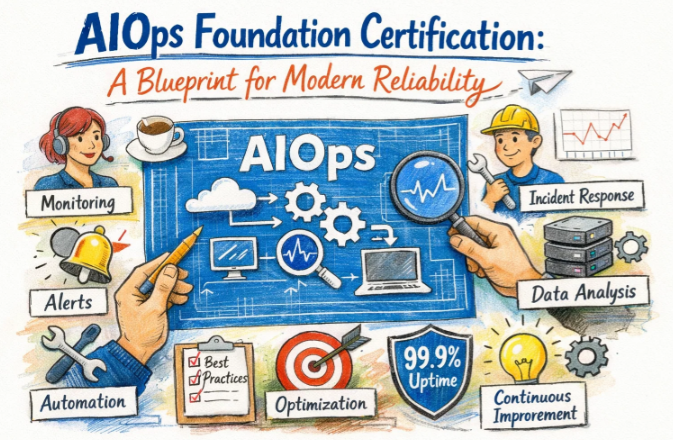
Introduction
The AIOps Foundation Certification represents a critical shift in how modern infrastructure is managed and scaled. As systems grow in complexity, manual intervention is no longer a viable strategy for maintaining uptime and performance. This guide is designed for engineers and technical managers who recognize that Artificial Intelligence for IT Operations is the next logical step in the evolution of DevOps and Site Reliability Engineering. By understanding the core principles of this discipline, professionals can transition from reactive troubleshooting to proactive, data-driven system management.
This comprehensive roadmap is hosted and supported by AIOps School, a platform dedicated to bridging the gap between traditional operations and machine learning-enhanced automation. Whether you are a cloud architect or a platform engineer, this guide will help you navigate the various certification tiers and understand their practical application in enterprise environments. We focus on providing a clear perspective on how these credentials impact your salary, role responsibilities, and long-term career viability in an increasingly automated industry.
What is the AIOps Foundation Certification?
The AIOps Foundation Certification is a professional credential designed to validate an engineer’s understanding of applying machine learning and data analytics to IT operations. Unlike theoretical data science courses, this program focuses heavily on production environments and the real-world challenges of managing high-scale distributed systems. It covers the fundamental architecture of AIOps platforms, including data ingestion, pattern recognition, and automated remediation workflows.
In today’s enterprise landscape, organizations are moving away from siloed monitoring tools toward integrated observability platforms. This certification exists to ensure that professionals can effectively manage these platforms and interpret the insights generated by algorithmic analysis. It aligns with modern engineering workflows by emphasizing “observability-as-code” and the integration of AI models directly into the CI/CD pipeline and incident management lifecycle.
Who Should Pursue AIOps Foundation Certification?
This certification is primarily built for DevOps engineers, Site Reliability Engineers (SREs), and Cloud Architects who are responsible for maintaining system reliability. Security professionals and Data Engineers also find significant value here, as the techniques used for operational noise reduction are closely related to threat detection and data pipeline management. It serves as a bridge for those moving from traditional sysadmin roles into more advanced platform engineering positions.
From a managerial perspective, technical leaders and engineering managers should pursue this certification to better understand the capabilities and limitations of AI-driven operations. In the Indian market, where large-scale managed services are a cornerstone of the tech economy, this credential is becoming a requirement for senior roles. Globally, companies across North America and Europe are prioritizing candidates who can demonstrate a structured approach to reducing “MTTR” through intelligent automation.
Why AIOps Foundation Certification is Valuable and Beyond
The demand for AIOps expertise is driven by the sheer volume of telemetry data produced by microservices and cloud-native architectures. Traditional monitoring often leads to “alert fatigue,” where engineers are overwhelmed by non-actionable notifications. This certification proves that a professional knows how to use AI to filter this noise, allowing teams to focus on high-value architectural improvements rather than constant fire-fighting.
As enterprise adoption of multi-cloud environments continues to rise, the ability to manage cross-platform data becomes a strategic advantage. Holding an AIOps Foundation Certification ensures that you remain relevant even as specific monitoring tools change or evolve. It represents a long-term investment in your career by shifting your focus from tool-specific knowledge to fundamental algorithmic operations, which is a skill set that carries a high return on investment in the global job market.
AIOps Foundation Certification Overview
The program is delivered via the official portal and is hosted on the primary provider website. The assessment approach is designed to be practical, testing a candidate’s ability to apply concepts to real-world scenarios rather than just memorizing definitions. The ownership of the certification lies with an industry-recognized body that ensures the curriculum stays updated with the latest advancements in large language models and predictive analytics.
The structure is divided into logical modules that cover the end-to-end AIOps lifecycle. Candidates start with the basics of data collection and move through event correlation, root cause analysis, and finally, closed-loop automation. This modular approach allows professionals to learn at their own pace while ensuring they gain a holistic view of how AI transforms the standard IT operating model.
AIOps Foundation Certification Tracks & Levels
The certification hierarchy is structured to support professionals at every stage of their career journey. The Foundation level focuses on the “what” and “why,” establishing a common vocabulary and understanding of the AIOps landscape. It is the entry point for anyone looking to modernize their operational skill set without necessarily having a background in data science.
The Professional and Advanced levels dive deeper into the “how,” focusing on the implementation of specific algorithms and the integration of AI into existing DevOps toolchains. These levels include specialization tracks for different disciplines. For instance, an SRE might focus on predictive scaling, while a FinOps practitioner might focus on AI-driven cost optimization. This alignment ensures that as you progress in your career, your certifications reflect your specialized expertise.
Complete AIOps Foundation Certification Table
| Track | Level | Who it’s for | Prerequisites | Skills Covered | Recommended Order |
| Core Operations | Foundation | Aspiring AIOps Engineers | Basic IT/DevOps knowledge | Data ingestion, Noise reduction | 1 |
| Engineering | Professional | SREs and DevOps Pros | Foundation Level | Pattern matching, RCA automation | 2 |
| Architecture | Advanced | Solutions Architects | Professional Level | Scaling AI models, Governance | 3 |
| FinOps | Specialist | Cloud Cost Managers | Basic Cloud Finance | Predictive billing, Spot instance AI | 2 (Optional) |
| Security | Specialist | DevSecOps Engineers | Security Fundamentals | Anomaly detection, Threat hunting | 2 (Optional) |
Detailed Guide for Each AIOps Foundation Certification
AIOps Foundation Certification – Foundation Level
What it is
This certification validates a candidate’s understanding of the core pillars of AIOps. It confirms that the individual can distinguish between traditional monitoring and AI-driven observability and understands the basic data requirements for training operational models.
Who should take it
This is ideal for junior to mid-level engineers, project managers, and students who want to enter the world of automated operations. It is also suitable for senior leaders who need a high-level technical understanding of AIOps to make informed procurement and hiring decisions.
Skills you’ll gain
- Understanding the AIOps market and tool landscape.
- Identifying the differences between descriptive, predictive, and prescriptive analytics.
- Knowledge of telemetry data types including Logs, Metrics, and Traces.
- Grasping the concept of event correlation and deduplication.
Real-world projects you should be able to do
- Design a high-level architecture for an observability pipeline.
- Evaluate and select appropriate AIOps tools for a specific enterprise use case.
- Create a roadmap for transitioning from manual monitoring to AI-enhanced alerting.
Preparation plan
- 7-14 days: Focus on terminology, reading whitepapers, and understanding the core AIOps lifecycle.
- 30 days: Engage with lab environments, practice with sample data sets, and study case studies of successful implementations.
- 60 days: Conduct a deep dive into integration strategies and participate in community forums to solve complex architectural problems.
Common mistakes
- Treating AIOps as a “magic box” rather than a data-driven discipline.
- Neglecting the importance of clean, high-quality data ingestion.
- Focusing too much on specific tools rather than the underlying logic and workflows.
Best next certification after this
- Same-track option: AIOps Professional Certification.
- Cross-track option: SRE Professional Certification.
- Leadership option: ITIL Leader Digital and IT Strategy.
AIOps Foundation Certification – Professional Level
What it is
The Professional level validates the technical ability to implement and manage AIOps solutions. It confirms that the engineer can configure machine learning models for specific operational tasks and integrate them into existing workflows.
Who should take it
Senior DevOps engineers and SREs with at least 2-3 years of experience in automation should take this. It is for those who are actively responsible for building and maintaining the “plumbing” of an organization’s monitoring infrastructure.
Skills you’ll gain
- Implementation of supervised and unsupervised learning for IT tasks.
- Configuring automated root cause analysis (RCA) engines.
- Setting up predictive alerting and capacity planning models.
- Managing “Human-in-the-loop” workflows for automated remediation.
Real-world projects you should be able to do
- Deploy a fully automated incident response system using AIOps.
- Build a predictive scaling engine for a Kubernetes-based microservices architecture.
- Implement a noise-reduction layer that reduces alert volume by over 70 percent.
Preparation plan
- 7-14 days: Hands-on configuration of popular AIOps platforms and reviewing API documentation.
- 30 days: Building pilot projects that involve real-time data streaming and pattern recognition.
- 60 days: Fine-tuning models for accuracy and developing custom scripts for automated remediation.
Common mistakes
- Over-automating without sufficient guardrails or manual overrides.
- Ignoring the “black box” problem where engineers do not understand why an AI made a decision.
- Failing to account for model drift as the underlying infrastructure changes.
Best next certification after this
- Same-track option: AIOps Advanced/Architect Certification.
- Cross-track option: MLOps Specialist Certification.
- Leadership option: Principal Engineer Leadership Program.
Choose Your Learning Path
DevOps Path
The DevOps path focuses on integrating AIOps into the continuous delivery pipeline to ensure that deployments do not degrade system performance. This involves using AI to analyze deployment patterns and automatically roll back changes if an anomaly is detected in the staging or production environment. Engineers on this path prioritize the speed of delivery without compromising the stability of the overall platform. It is a transition from manual gatekeeping to algorithmic quality assurance.
DevSecOps Path
In the DevSecOps path, AIOps is utilized to identify security vulnerabilities and threats in real-time by analyzing massive volumes of security logs. By applying machine learning to access patterns and network traffic, professionals can detect “zero-day” anomalies that traditional signature-based tools might miss. This path emphasizes the convergence of operational health and security posture. It enables a proactive defense mechanism where security incidents are mitigated before they can escalate into data breaches.
SRE Path
The Site Reliability Engineering path leverages AIOps to maintain strict Service Level Objectives (SLOs) through predictive maintenance. SREs use these certifications to build systems that can predict potential failures based on historical trends and current telemetry. This path is deeply focused on reducing toil and improving the “Error Budget” management through intelligent automation. It allows SRE teams to move away from mundane monitoring and toward high-level reliability engineering and architectural resilience.
AIOps Path
The dedicated AIOps path is for those who wish to become subject matter experts in the specialized field of algorithmic IT management. This involves a deep focus on data science for operations, including the selection of the right algorithms for specific IT use cases like log clustering or metric forecasting. Professionals here are often responsible for the entire AIOps platform strategy within an enterprise. They act as the bridge between the data science team and the traditional IT operations team.
MLOps Path
The MLOps path is distinct as it focuses on the operationalization of machine learning models themselves, ensuring they are deployed, monitored, and retrained effectively. While AIOps uses AI to help IT, MLOps uses DevOps principles to help AI stay accurate and functional in production. This path is essential for organizations that rely on proprietary machine learning models to drive their business logic. It ensures that the lifecycle of a model is as robust and repeatable as a standard software release.
DataOps Path
DataOps professionals focus on the reliability and quality of the data pipelines that feed into AIOps and other business intelligence systems. This path applies the principles of AIOps to the data infrastructure itself, ensuring that data is delivered on time and is free from errors. By using AI to monitor data health, these engineers prevent “garbage in, garbage out” scenarios that can lead to incorrect automated decisions. It is the foundation upon which all other AI-driven operations are built.
FinOps Path
The FinOps path applies AIOps to cloud financial management to ensure maximum value for every dollar spent on cloud resources. AI is used to forecast spending, identify waste in real-time, and recommend the most cost-effective resource allocations across multi-cloud environments. This path bridges the gap between engineering, finance, and business units by providing transparent and predictive cost insights. Professionals here help organizations avoid “cloud bill shock” through automated cost-governance policies.
Role → Recommended AIOps Foundation Certifications
| Role | Recommended Certifications |
| DevOps Engineer | AIOps Foundation, DevOps Professional |
| SRE | AIOps Professional, Site Reliability Associate |
| Platform Engineer | AIOps Advanced, Kubernetes Administrator |
| Cloud Engineer | AIOps Foundation, Cloud Architect |
| Security Engineer | AIOps Foundation, DevSecOps Specialist |
| Data Engineer | DataOps Professional, AIOps Foundation |
| FinOps Practitioner | FinOps Certified, AIOps Foundation |
| Engineering Manager | AIOps Foundation, Management Essentials |
Next Certifications to Take After AIOps Foundation Certification
Same Track Progression
Once the Foundation level is completed, the natural progression is to move toward the Professional and Advanced tiers. These certifications delve into the specific mathematical models and data engineering required to build custom AIOps solutions. Deepening your expertise in this track establishes you as a niche expert in a high-demand field. It allows you to lead large-scale digital transformation projects where AI is the primary driver of operational efficiency.
Cross-Track Expansion
For those who want to be more versatile, expanding into MLOps or DevSecOps is a highly effective strategy. Understanding how to manage the lifecycle of an AI model (MLOps) complements the skill of using AI for operations (AIOps). Similarly, applying AIOps principles to security (DevSecOps) makes you a formidable asset in protecting enterprise assets. This breadth of knowledge allows you to collaborate across different departments and solve complex, multi-disciplinary problems.
Leadership & Management Track
If your goal is to move into management, combining AIOps knowledge with leadership certifications like ITIL or PMP is recommended. This path is about understanding how to integrate AI into the broader business strategy and managing the cultural shift that comes with automation. It prepares you for roles like VP of Infrastructure or Chief Technology Officer. You will learn how to justify the budget for AI initiatives and how to structure teams for an AI-first future.
Training & Certification Support Providers for AIOps Foundation Certification
DevOpsSchool
DevOpsSchool provides a robust ecosystem for professionals looking to master the intersection of development and operations. Their curriculum is deeply rooted in practical implementation, offering extensive lab environments that simulate real-world production challenges. They focus on empowering engineers with the skills needed to automate entire lifecycles, making them a premier choice for those pursuing foundational AIOps knowledge. With a strong emphasis on community and peer learning, DevOpsSchool ensures that students are not just learning theory but are also prepared for the cultural shifts required in modern tech organizations. Their trainers are industry veterans who bring a wealth of practical experience to every session they conduct globally.
Cotocus
Cotocus is recognized for its specialized approach to advanced technical training and consulting in the cloud-native space. They provide tailored learning paths that help engineers navigate the complexities of modern infrastructure and intelligent automation. Their methodology involves a mix of deep-dive technical sessions and strategic workshops designed to solve specific enterprise problems. Cotocus excels at bridging the gap between high-level architectural concepts and the hands-on technical skills required to implement them effectively. For those seeking AIOps Foundation Certification support, they offer a clear roadmap that aligns technical proficiency with business outcomes, ensuring that certified professionals can drive meaningful change within their respective organizations and teams.
Scmgalaxy
Scmgalaxy serves as a comprehensive knowledge hub and training provider for software configuration management and DevOps professionals. They host a massive repository of tutorials, community forums, and expert-led training sessions that cover the entire software delivery spectrum. Their focus on AIOps reflects a commitment to staying at the forefront of industry trends and providing learners with future-proof skills. Scmgalaxy is particularly valuable for its extensive collection of real-world use cases and troubleshooting guides that help professionals apply their learning to daily tasks. By fostering a collaborative environment, they enable engineers to share insights and stay updated on the latest tools and methodologies in the automated operations landscape.
BestDevOps
BestDevOps is dedicated to providing high-quality, curated training programs that focus on the most effective tools and practices in the industry. They emphasize a “best-of-breed” approach, helping professionals identify which technologies are truly worth their time and investment. Their AIOps training modules are designed to be concise yet comprehensive, making them ideal for busy professionals who need to gain new skills quickly. BestDevOps focuses on clear, actionable learning that can be immediately applied to improve system reliability and team productivity. Their reputation is built on a foundation of integrity and a deep understanding of what makes an engineering team successful in a competitive, fast-paced global market.
devsecopsschool.com
DevSecOpsSchool is a specialized platform focused on the critical integration of security into the DevOps and AIOps lifecycles. They recognize that automation without security is a major risk, and their curriculum is designed to teach professionals how to build “secure by design” systems. Their training programs cover everything from automated compliance to AI-driven threat detection, providing a holistic view of modern infrastructure protection. By focusing on the convergence of security and operations, devsecopsschool.com prepares engineers to handle the complex regulatory and safety requirements of today’s digital world. They are an essential resource for anyone looking to ensure their AIOps initiatives are robust and resilient against evolving cyber threats.
sreschool.com
SRESchool is dedicated specifically to the discipline of Site Reliability Engineering, emphasizing the principles of scalability, availability, and performance. They provide deep-dive training on how to use AIOps to manage error budgets, reduce toil, and implement automated incident response. The curriculum at sreschool.com is built around the “Google-style” SRE model but adapted for various enterprise sizes and industries. Their focus is on practical reliability, teaching students how to use data-driven insights to make better architectural decisions. For those pursuing AIOps certifications, SRESchool offers a unique perspective on how machine learning can be the ultimate tool for maintaining high-availability systems in a complex, multi-cloud environment.
aiopsschool.com
AIOpsSchool is the primary authority and dedicated learning platform for Artificial Intelligence in IT Operations. It provides a structured and comprehensive curriculum that covers everything from data science basics for engineers to advanced algorithmic automation. The platform is designed to be the definitive resource for professionals seeking AIOps Foundation Certification and beyond. With a focus on industry-recognized standards and hands-on practice, aiopsschool.com ensures that its students are ready to lead the next generation of IT management. Their content is constantly updated to reflect the latest advancements in AI, providing a reliable and future-proof learning path for anyone looking to specialize in this transformative and high-impact technical field.
dataopsschool.com
DataOpsSchool focuses on the essential data pipelines and management practices that power modern AI and analytics engines. They teach professionals how to apply DevOps principles to data workflows, ensuring high data quality and fast delivery for AIOps platforms. The curriculum covers data engineering, automated testing for data, and the orchestration of complex data environments. By emphasizing the importance of a solid data foundation, dataopsschool.com helps engineers avoid the pitfalls of unreliable or biased data in their automation efforts. This platform is a critical resource for those who want to ensure that their AIOps implementations are built on a bedrock of trustworthy, timely, and actionable operational data.
finopsschool.com
FinOpsSchool addresses the growing need for financial accountability and optimization in cloud computing through AI-driven insights. They provide training on how to integrate AIOps into financial operations to predict costs, identify waste, and automate budget enforcement. Their programs are designed for a cross-functional audience, including engineers, finance professionals, and business leaders. FinOpsSchool focuses on the cultural and technical shifts required to manage cloud spend effectively in a variable-cost model. By teaching professionals how to leverage AI for cost-transparency, they enable organizations to maximize their return on cloud investment and align technical spending with overall business goals in a data-driven and highly predictable manner.
Frequently Asked Questions (General)
- How difficult is the AIOps Foundation Certification?
The difficulty level is moderate. It requires a solid understanding of IT operations and basic data concepts but does not require you to be a mathematician or a data scientist. - How long does it take to prepare for the exam?
Most professionals with a DevOps background can prepare in 30 days. Those new to the field may require 60 days to fully grasp the architectural concepts. - Are there any prerequisites for the foundation level?
There are no formal prerequisites, though a basic understanding of cloud computing and monitoring tools is highly recommended for success. - What is the return on investment (ROI) for this certification?
Professionals often see a significant increase in salary and are eligible for more senior roles like “Lead SRE” or “AIOps Architect.” - Is this certification recognized globally?
Yes, it is recognized by major enterprises and service providers across India, North America, Europe, and Asia-Pacific regions. - How often should I renew my certification?
The certification is typically valid for two to three years, after which a renewal or a move to a higher level is recommended to stay current. - Does this certification cover specific tools like Splunk or Datadog?
It focuses on the underlying principles and logic that apply to all major tools, though it may use popular platforms for practical examples. - Can a manager benefit from this technical certification?
Absolutely. It provides the technical vocabulary and understanding needed to lead teams and make strategic tool-buying decisions. - Is there a practical component to the exam?
Yes, most levels include scenario-based questions that test your ability to apply AIOps logic to production-style problems. - How does this differ from a standard Data Science certification?
Data science is broad and theoretical; this is specifically tailored for IT operations and production system management. - Are there community groups for certified professionals?
Yes, the provider maintains active forums and LinkedIn groups where certified individuals can network and share knowledge. - What is the best way to study for the assessment?
A combination of official training videos, hands-on labs, and reviewing real-world case studies is the most effective approach.
FAQs on AIOps Foundation Certification
- What is the primary focus of the AIOps Foundation Certification?
The focus is on using machine learning to enhance IT operations, specifically in the areas of monitoring, incident management, and automated remediation. - Does the curriculum include Generative AI?
Yes, modern versions of the curriculum include the use of Large Language Models (LLMs) for log analysis and automated documentation. - How does this certification help with “Alert Fatigue”?
It teaches specific techniques for event correlation and deduplication, ensuring that engineers only receive notifications for significant, actionable issues. - Is knowledge of Python required?
While not strictly required for the foundation level, basic scripting knowledge is very helpful for the professional and advanced tracks. - Can I take the exam online?
Yes, the certification exams are typically proctored online, allowing candidates to take them from anywhere in the world. - How does AIOps Foundation Certification relate to SRE roles?
It provides the “A” in SRE automation, helping SREs build systems that can self-heal and predict failures before they happen. - Is it worth it for small companies?
Yes, even smaller teams can benefit from the efficiency gains of AI, though the scale of data will be different than in an enterprise. - What is the passing score for the exam?
The passing score usually ranges between 70 percent and 75 percent, depending on the specific version of the assessment.
Final Thoughts: Is AIOps Foundation Certification Worth It?
In my two decades of experience observing the evolution of IT, I have seen many trends come and go, but the move toward algorithmic operations is not a passing fad—it is a necessity. The complexity of modern systems has simply outpaced human capacity to manage them manually. This certification is a signal to the market that you understand this reality and are prepared to lead in an automated environment.
If you are looking to future-proof your career and move away from the “fire-fighting” culture of traditional operations, this credential is an excellent starting point. It provides a structured path to mastering a complex subject and gives you a significant edge in a competitive job market. My advice is to approach it not just as a badge for your resume, but as a framework for how you will build and manage the systems of the future.

Best Cardiac Hospitals Near You
Discover top heart hospitals, cardiology centers & cardiac care services by city.
Advanced Heart Care • Trusted Hospitals • Expert Teams
View Best Hospitals